Two-thirds of children who can’t read proficiently by 4th grade will end up in jail or on welfare. KIPP Chicago is changing that.
Frederick Douglass said it plainly: “Once you learn to read, you will be forever free.”
He knew from lived experience that literacy is not a classroom skill; it is the foundation of a life with options. It is the difference between a child who chooses their future and one whose future is chosen for them.
At KIPP Chicago, we believe this, too. We have built our schools around it. And now, we are making it the centerpiece of our commitment to the more than 3,500 students and families we serve.
We are proud to introduce the Road to FREADom—a multi-year movement to transform literacy outcomes for our students and disrupt the poverty-to-prison pipeline.
Education is in Crisis
The statistics are stark. Two-thirds of students who cannot read proficiently by the end of 4th grade will end up in jail or on welfare. Third grade is the year that experts identify as the turning point—the year children shift from learning to read to reading to learn. Miss that window, and the consequences follow a child for life.
Nationally, two in three students are not reading proficiently by 4th grade. Among Black and Hispanic/Latino students, who make up 99% of the students we serve, that gap is even wider. In Illinois, only 22.6% of Black students and 25.5% of Hispanic/Latino students in 3rd to 8th grade read at grade level in 2024.
The illiteracy to poverty and prison pipeline runs directly through our classrooms and across our city. And at KIPP Chicago, we stand committed to dismantling it. Through research-backed instruction, a joyful reading culture, and the belief that our students deserve a life of opportunity, we will begin to write a new story for Chicago’s youth.
Our Approach: FREADom from Every Angle
The Road to FREADom is not a single program. It is a commitment that spans instruction, culture, community, and access, built on the understanding that learning thrives when a child is supported from every direction.
The Science of Reading
Our foundation is evidence-based literacy instruction grounded in the Science of Reading, a body of research that identifies how the brain learns to decode language and what instructional approaches produce the strongest outcomes. Paired with i-Ready, our adaptive assessment and instructional platform, we use real-time data to meet every student exactly where they are and accelerate their growth.
The Frederick Douglass FREADom Initiative
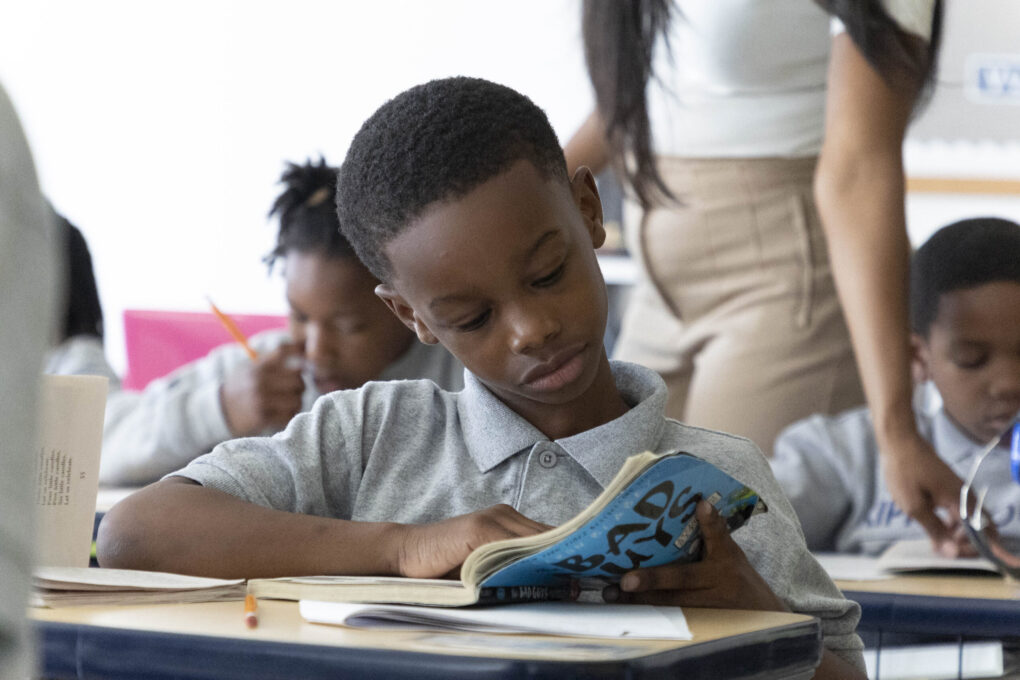
Great instruction gets students reading. The Frederick Douglass FREADom Initiative ensures they fall in love with it. Launched in the 2025–2026 school year, this initiative challenges our 3,500 students to collectively reach 1 million reading minutes. Through Beanstack, our gamified digital reading platform, students track progress, earn badges, and compete on leaderboards in a network-wide reading challenge.
The initiative goes beyond the page, building a culture of reading through arts-integrated literacy programming, like family literacy nights, author visits, and visual and performing arts projects curated in partnerships with leading Chicago-based literacy and cultural organizations like Once Upon Our Time Capsule, Burst Into Books, Bernie’s Book Bank, Open Books, and Young Chicago Authors.
A City-Wide Conversation
The Road to FREADom has always been bigger than our eight campuses. Solving the literacy crisis in Chicago will require educators, families, policymakers, philanthropists, and civic leaders to come together. Through a series of thought leadership and community convenings, we will work to elevate the conversation and inspire citywide action around literacy.

The first of many community convenings will be held on Thursday, June 18, at the Chicago Cultural Center. We invite you to join us for a private screening of the powerful documentary, Sentenced, followed by a discussion with Chicago native and nationally recognized expert on the literacy development of African American youth, Dr. Alfred Tatum, to address one of our nation’s most pressing issues in education today.